admin
admin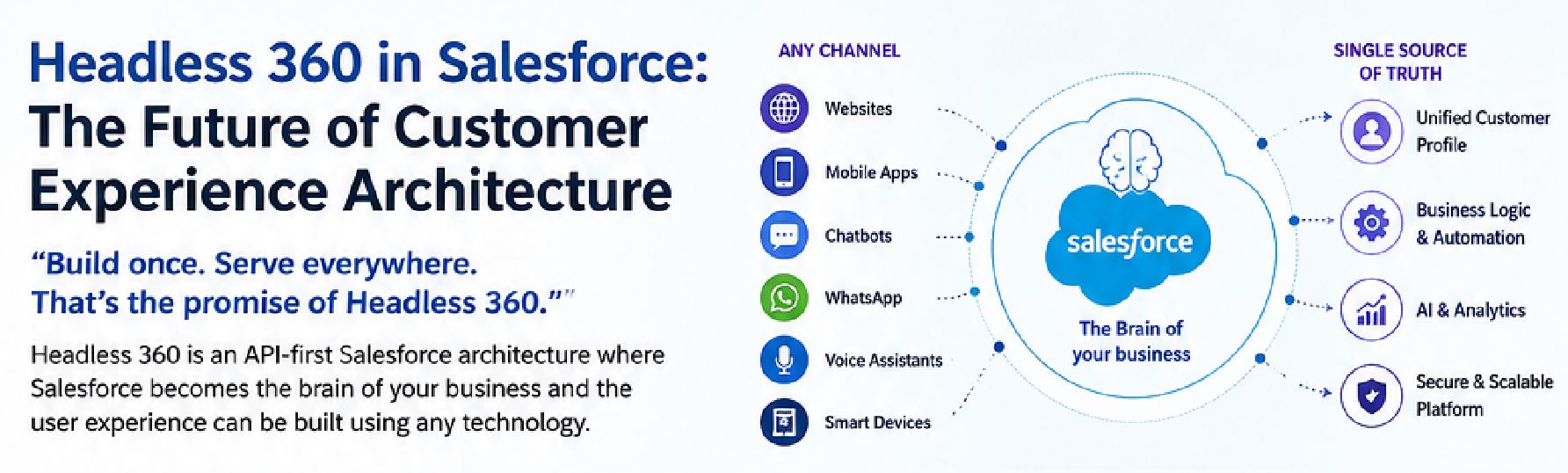
“Build once. Serve everywhere. That’s the promise of Headless 360.”
As customer expectations continue to evolve, businesses are expected to deliver seamless experiences across websites, mobile apps, chatbots, smart devices, kiosks, and even AI assistants.
The challenge?
Maintaining consistent customer information and business processes across all these channels.
This is where Headless 360 comes into the picture.
What is Headless 360?
Headless 360 is an API-first Salesforce architecture where Salesforce becomes the brain of your business, while the user interface can be built using any technology.
Instead of customers interacting directly with Salesforce screens, they interact with:
- React applications
- Angular websites
- Flutter mobile apps
- iOS applications
- Android applications
- AI Agents
- Chatbots
- Voice assistants
- Smart devices
These applications communicate with Salesforce through APIs.
Think of Salesforce as the operating system powering every customer interaction behind the scenes.
Traditional Salesforce Architecture
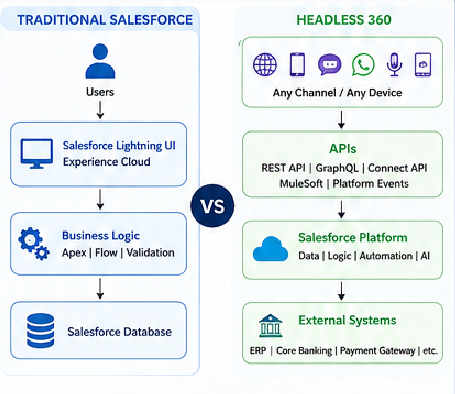
Most organizations begin with a traditional Salesforce implementation.
                Customer

                    │

                    ▼

        Salesforce Lightning UI

                    │

     ------------------------------

        Apex | Flow | Validation

     ------------------------------

                    │

          Salesforce Database
In this architecture:
- Users log into Salesforce.
- Business logic executes inside Salesforce.
- Customer data resides in Salesforce.
This works well for internal users such as:
- Sales teams
- Customer service agents
- Operations teams
However, it becomes limiting when customers interact through multiple digital channels.
What is Headless Architecture?
In a headless architecture, the front-end is completely independent of the back-end.
       Frontend (Head)

Website      Mobile App

Chatbot      Smart TV

Voice AI     Partner Portal

        │

        ▼

      APIs

        │

        ▼

 Salesforce Platform
Salesforce never controls the UI.
Instead, it exposes business capabilities through APIs.
Headless 360 Architecture
Here’s what a complete Salesforce Headless 360 solution typically looks like.
                    CUSTOMER

      Website

      Mobile App

      Chatbot

      WhatsApp

      Voice Assistant

      Smart Device

             │

             ▼

      API Gateway

             │

    ---------------------

    REST API

    GraphQL

    Connect API

    MuleSoft

    Platform Events

    ---------------------

             │

             ▼

        Salesforce

    ------------------------

    Sales Cloud

    Service Cloud

    Data Cloud

    Agentforce

    Flow

    Apex

    OmniStudio

    ------------------------

             │

             ▼

 External Systems

 Core Banking

 SAP

 Oracle

 Payment Gateway

 ERP
Notice something interesting?
Salesforce is no longer the application.
It has become the central business platform.
Why “360”?
The “360” represents a complete view of the customer.
Instead of storing customer information in isolated systems:
- Website
- Mobile App
- CRM
- Marketing
- Support
- Commerce
Everything is unified into a single customer profile.
Example:
Customer Name

Purchases

Support Cases

Marketing Preferences

Website Activity

Mobile Activity

AI Recommendations

Credit Score

Loyalty Status
Every application sees the same customer.
Role of Data Cloud
This is where Salesforce Data Cloud becomes incredibly powerful.
Data Cloud collects information from:
- CRM
- ERP
- SAP
- Banking systems
- Marketing Cloud
- Commerce Cloud
- Mobile applications
- Third-party APIs
It then creates a Unified Customer Profile.
CRM

ERP

Commerce

Marketing

Support

Website

Mobile

      │

      ▼

 Salesforce Data Cloud

      │

      ▼

 Customer 360 Profile
This unified profile enables personalization, analytics, and AI across every touchpoint.
Where Does Agentforce Fit?
One of the biggest advantages of Headless 360 is that AI becomes reusable across all channels.
Instead of embedding separate AI logic in every application:
Website

Mobile

WhatsApp

Voice Bot

Chatbot

Partner Portal

      │

      ▼

     Agentforce

      │

      ▼

 Salesforce Data

 Flows

 Apex

 Knowledge

 Customer History
One AI platform.
Multiple digital experiences.
Real Banking Example
Imagine a customer applying for a home loan.
Traditional Process
Customer visits the branch.
Employee logs into Salesforce.
Employee enters customer information.
Back-office teams process the application.
Response takes several days.
Headless 360 Process
Customer opens the bank’s mobile app.
↓
Enters personal details.
↓
App calls Salesforce APIs.
↓
Flow validates eligibility.
↓
Data Cloud enriches customer profile.
↓
Agentforce answers customer questions.
↓
Core banking integration checks account history.
↓
Loan decision is returned instantly.
The customer never interacts with Salesforce directly, yet Salesforce orchestrates the entire journey.
Benefits of Headless 360
| Benefit | Description |
|---|---|
| Faster user experience | Modern front-end frameworks outperform traditional CRM interfaces. |
| Omnichannel consistency | Customers enjoy the same experience across web, mobile, and messaging platforms. |
| Better scalability | Teams can evolve front-end and back-end independently. |
| Improved developer productivity | Front-end and Salesforce developers work in parallel. |
| Reusable business logic | Flows, Apex, and APIs are shared across all channels. |
| AI everywhere | Agentforce and Data Cloud power every touchpoint. |
| Reduced duplication | Business rules are implemented once and reused. |
Challenges
No architecture is perfect.
A Headless 360 implementation introduces additional complexity.
- API security (OAuth, JWT, API gateways)
- API versioning
- Monitoring distributed systems
- Higher infrastructure costs
- More sophisticated deployment pipelines
- Need for robust observability and logging
These trade-offs are often worthwhile for large-scale digital platforms.
When Should You Use Headless 360?
A Headless 360 approach is a strong fit when your organization needs to support:
- Mobile-first customer experiences
- Multiple digital channels
- AI-powered assistants
- High-performance websites
- External customer portals
- Partner ecosystems
- E-commerce platforms
- IoT or connected devices
For a small internal CRM used only by employees, the additional architectural complexity may not be justified.
Future of Salesforce
Salesforce is evolving from a traditional CRM into a Customer Intelligence Platform.
Future enterprise architectures will increasingly rely on:
- Agentforce
- Data Cloud
- MuleSoft
- API-first design
- Event-driven architectures
- Composable applications
- Headless experiences
Organizations that adopt these patterns can innovate faster and deliver consistent experiences across every customer touchpoint.